Comments on the initiative:
As a company that relies on combined transport on a daily basis, we can see clearly that without reliable rail infrastructure, there is a risk of falling behind on climate and logistics targets. Predictable capacities and stable framework conditions are essential to ensure sustainable supply chains in Europe.
Karsten Scheidhauer
Managing Director Optimodal Nederland B.V.
Now is the moment for our industry to stand up. The combined transport market needs the active support of all of us. Politics in Berlin must act now: the capital for infrastructure investments has been approved, and combined transport must clearly benefit from these announced investments. Combined transport is one of the key pillars to achieving our climate targets.
Dr. Jan Petzold
CEO Deucon Chemielogistik GmbH
For us, combined transport is not just a logistical concept, but the basis for efficient, safe and climate-friendly transport chains. In order to maintain this in the future, we need a stable rail network, predictable capacities and fair framework conditions. That is why we strongly support the initiative.
Maik Rehmer
COO Maxi Terminal Hamm
For decades, combined transport has combined the strengths of rail with the flexibility of road. For us as a railway undertaking, maintaining this is a strategic prerequisite for enabling growth, quality and climate protection in the logistics chain in Europe at the same time. Europe now needs clear priorities for efficient, affordable and climate-friendly rail logistics!
Sven Flore
CEO SBB Cargo International
Railway undertakings need a reliable environment with uninterrupted transport conditions and sufficient train path capacity – even during construction closures. This includes high-quality planning, the timely planning of construction-related restrictions by infrastructure operators, and stable train path prices that are only adjusted for inflation.
Marcel Theis
COO SBB Cargo International
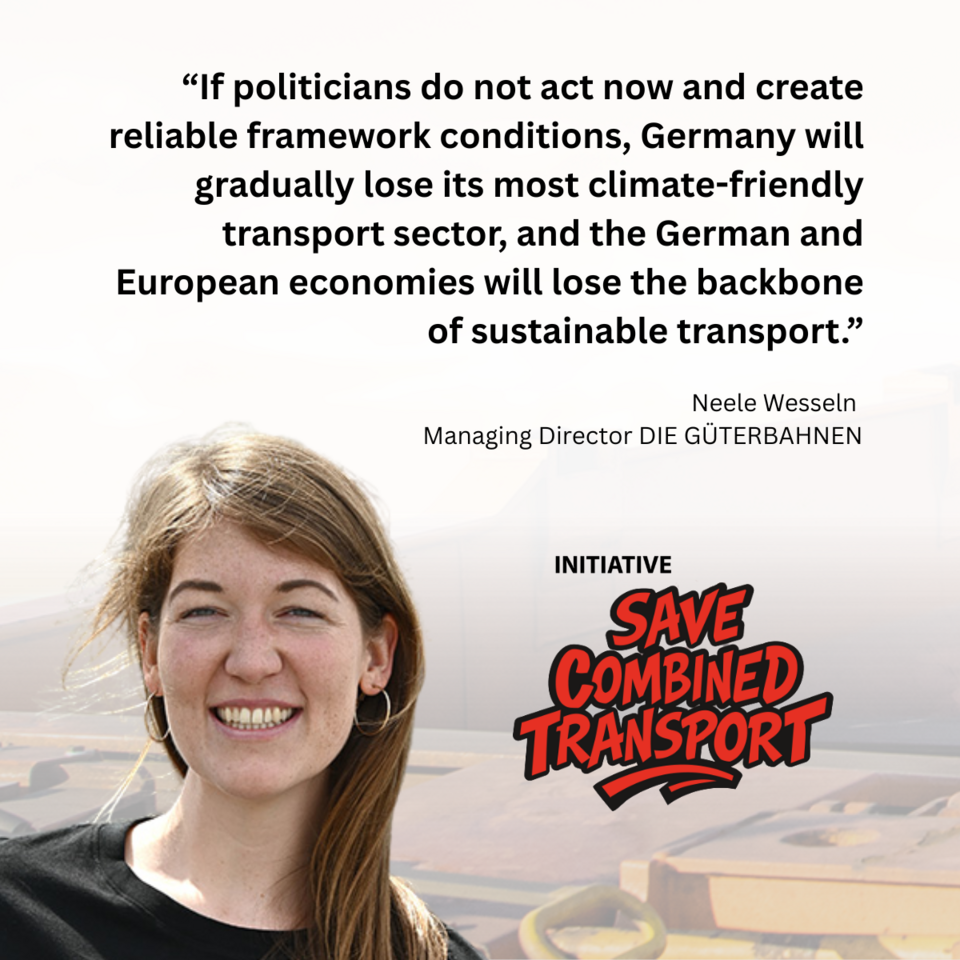
What threatens the KV today as a long-standing driver of the shift of traffic to the railroads will also affect the rest of rail freight transport tomorrow. Track access charges are rising dramatically, corridor renovations are leading to months of closures and uncertain detours with massive impacts on punctuality, capacity, and competitiveness. If politicians do not act now and create reliable framework conditions, Germany will gradually lose its most climate-friendly transport sector, and the German and European economies will lose the backbone of sustainable transport.
Neele Wesseln 
Managing Director DIE GÜTERBAHNEN
Cities and municipalities are implementing a wide range of measures to create sustainable and climate-friendly logistics solutions in order to strengthen and further develop business locations. Combined transport plays a central role in this, especially in conurbations. The Augsburg Region Freight Transport Centre expressly supports this initiative in order to ensure the security of supply for our businesses through the use of different modes of transport. 
Ralf Schmidtmann
Managing Director GVZ-Entwicklungsmaßnahmen GmbH, Augsburg
We endorse and support the petition. Particularly in the sensitive Alpine region, European trade is inconceivable without a functioning combined transport system and a clear commitment to better linking the advantages of road and rail.
Ruby van der Sluis
Managing Director, Lokomotion GmbH
Two centuries ago the railway fathered the social and industrial development of all our nations. Today its best offspring, Combined Transport, is in danger. Ambrogio Intermodal, pioneer operator since 1969, has witnessed its growing fortune over the decades. It simply cannot be allowed that Combined Transport be killed by its own success.
Livio Ambrogio
President Ambrogio Intermodal
Combined transport is the solution for sustainable rail logistics. Its strong growth to date and numerous innovations speak for themselves. If politicians fail to provide sufficient support for combined transport during the (undoubtedly necessary) renovation phase of the rail network, they will be undermining their own modal shift and climate targets in the transport sector.
Sebastian Ruckes
CEO shift2030 e.V.
Relocation is not an end in itself – it is our shared responsibility.Politicians, businesses and society must act now to ensure that our descendants inherit an intact environment.In addition to CO₂, the focus is primarily on massive tyre abrasion with fine dust and microplastics.A resilient supply chain needs genuine connectivity – and that is exactly what combined transport stands for. That is why I support this initiative.
Marc Hunziker
Owner Intermodalist GmbH
As a medium-sized business owner who relies on combined transport every day, I expect solutions instead of excuses. Rail transport must become reliable again. Combined transport has its back against the wall. It is high time that political commitments are turned into concrete relief measures and investments.
Michael Schaaf
Geschäftsleitung, Bay Logistik GmbH + Co. KG
Combined transport has proven its reliability over many years and makes an important contribution to stable, sustainable logistics. Clear political framework conditions are needed to maintain this potential: fair competition, reliable infrastructure and predictable track access charges. Only then can economic efficiency and climate protection be effectively combined in freight transport.
Ralph Reincken
Branch Manager & Head of Intermodal, Paneuropa Transport GmbH
When politicians slow down rail development, they also slow down innovation. Without planning security and reliable funding, start-ups such as RailSync lose ground, and Germany and Europe lose the opportunity for greater digitalisation and increased rail capacity.
Christoph Kappler
Managing Director & Founder, RailSync GmbH
Without reliable infrastructure, functioning diversion routes and a pause in cost increases, rail is losing market share. Combined transport is an indispensable element of European security of supply and competitive logistics in port connections, intra-European and transalpine transport. We must save combined transport now.
Jan Arnet
CEO, Bertschi Group
Zero increase in track access charges, guaranteed capacity, suitable diversion routes, and proper compensation are indeed essential measures to adopt urgently in order to preserve the fragile economic equilibrium of these operations and for the benefit of the whole rail freight sector. ERFA is ready to work with other signatories and the German authorities to develop practical solutions to reconcile renovation and users’ needs.
Josselin Petit 
Acting Secretary General, ERFA
This initiative clearly shows that the combined transport community is united and cannot be divided. Combined transport is the backbone of the transport system, an independent mode of transport with all its advantages and efficiencies, but also with common challenges. All players in the logistics chain agree that there is no better solution for sustainable resilience and that the framework conditions for competitiveness are crucial, both on the legal side and in terms of infrastructure.
Ralf-Charley Schultze 
Director General, UIRR 
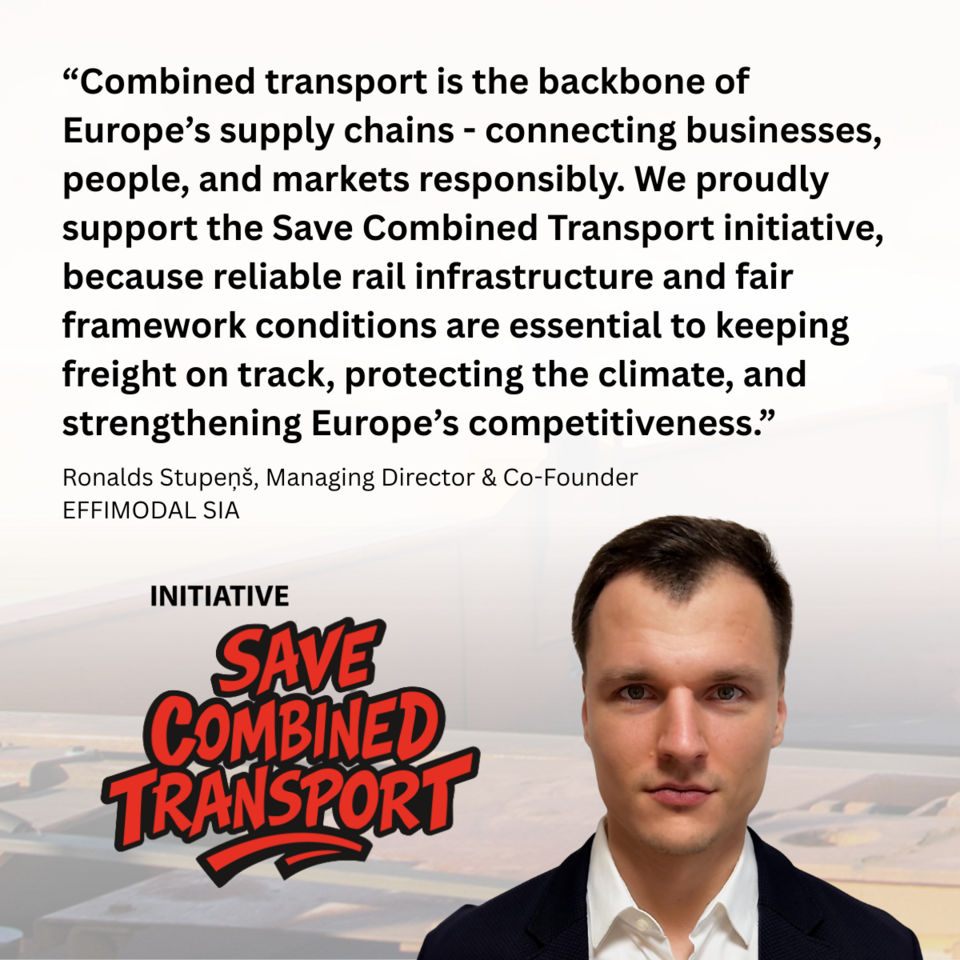
Combined transport is the backbone of Europe’s supply chains - connecting businesses, people, and markets responsibly. We proudly support the Save Combined Transport initiative, because reliable rail infrastructure and fair framework conditions are essential to keeping freight on track, protecting the climate, and strengthening Europe’s competitiveness.
Ronalds Stupeņš 
Managing Director & Co-Founder, EFFIMODAL SIA 
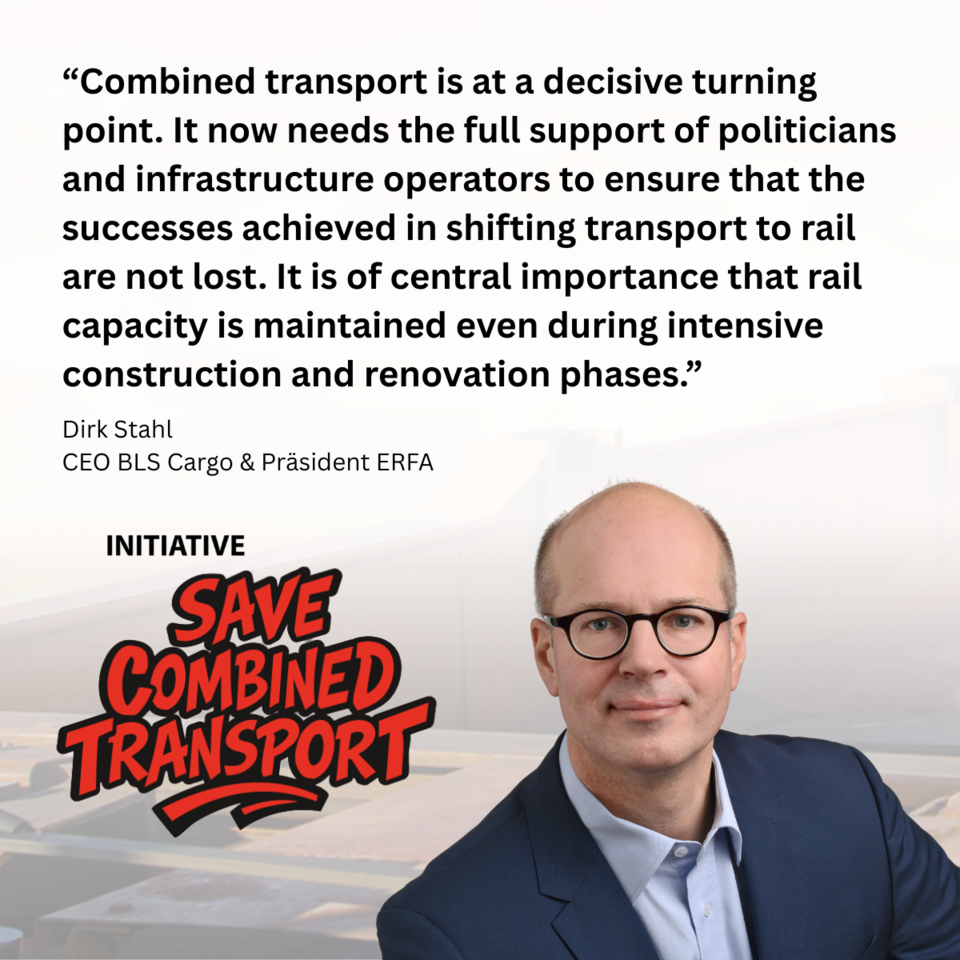
Combined transport is at a decisive turning point. It now needs the full support of politicians and infrastructure operators to ensure that the successes achieved in shifting transport to rail are not lost. It is of central importance that rail capacity is maintained even during intensive construction and renovation phases. Only in this way can we stabilise and further advance the modal shift from road to rail in the long term.
Dirk Stahl
CEO BLS Cargo & Präsident ERFA
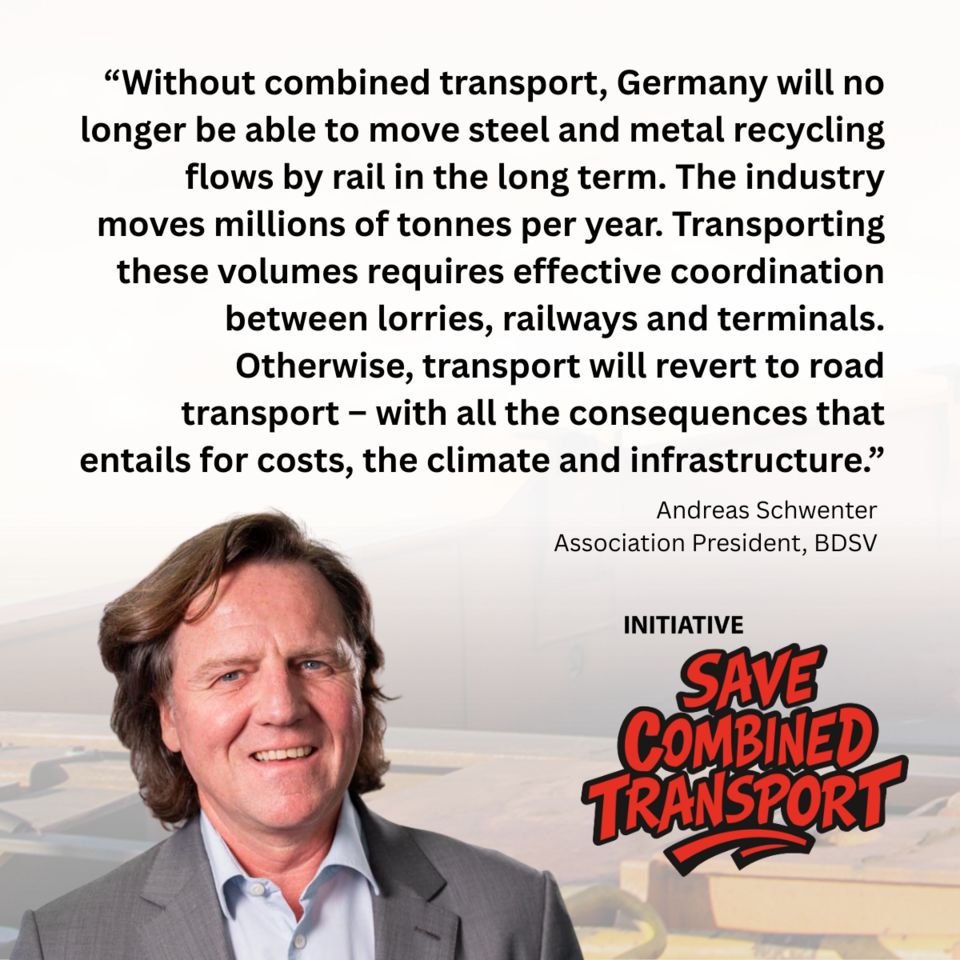
Without combined transport, Germany will no longer be able to move steel and metal recycling flows by rail in the long term. The industry moves millions of tonnes per year. Transporting these volumes requires effective coordination between lorries, railways and terminals. Otherwise, transport will revert to road transport – with all the consequences that entails for costs, the climate and infrastructure.
Andreas Schwenter
Verbandspräsident, BDSV